 Jan. 19/20, 2017
Florence has about 400,000 people and is the ‘richest’ city in Italy. It has no true industry other than tourism, banking and handicrafts. It can not do any more spreading outward because the city has limited where homes and businesses can be built. One interesting story was the one about the Nov. 4, 1966 flood. The Arno bridge overflowed and water ran into the town centers, climbing buildings up to 17′ high. It killed 101 people and damaged or destroyed millions of masterpieces of art and rare books. Much effort has gone into restoration of these works of art, but there are still some that need restored.
We took the fast train to Florence from Venice and it took about 1.5 hours. Once in town we hopped on the bus to our hotel which cost 1.25 E per person. Once settled in we hustled off to town (by foot) so we could visit the Uffizi Museum. The most wonderful thing of traveling ‘off season’ is the fact that there are NO lines! We walked right in! (The cost is 8 E per person).
Before entering the museum we first walked through the courtyards that is lined with sculptures. This U shaped courtyard was purposely built that shape and went from Arno river to the Plaza de Signoria. It was built this way to be theatrical!
Uffizi actually means the ‘offices’ and indeed this is a building that is over 200 years full of different offices. the Top floor was the area for art, but now many floors hold pieces of work. If you follow the suggested path you basically follow the history and evolution of art. It is full of so many pieces of art that you need to just stop and take it all in at different moments of the tour.
We then left and went to the Duomo Cathedral. After some investigations we found out there was a ticket you purchased for 15 E per person that allowed you into 5 places. 1) the basement museum of the Duomo (the least exciting of the sites), 2) the Baptismal 3) the climb to the top of the tower, 4) the climb top of the Duomo and lastly 5)the museum for the Duomo ( a bit down the street). It is good for 48 hours, BUT you can only enter/exit each site ONE time!
 The Duomo is the 3rd largest church in Europe and Duomo means the “home or house of God”. It was started in the 13th Century and finished early in the 1400’s.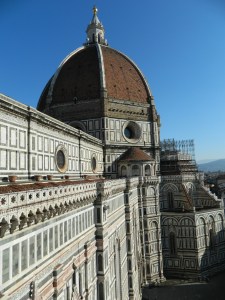
One other tip; YOU MUST pick a time for each of these sites, SO go across from the entry to the Baptismal and look for DOOR #7. There are machines in there that allow you to pick your times. DON’T lose the slips of paper they give you for entry to the sites FOR SPECIFIC TIMES!
Day 2
We cranked it today…9-11 walking tour, 11:30-12:15 hiked to the top of the tower, 12:30-1:30 Academia Museum~ The David, 2:30-3:00 Baptismal, 3:00-4:00 wine and snack, 4:30-6:00 climb to top of Duomo and watched the sunset, 6:30-7:15 dinner, 7:30 Ponte Vecchio Bridge.
The Tower was only 414 steps but the stairs are VERY narrow and when you meet someone coming there in no way to avoid physical contact. Thankfully it wasn’t hot in January! It was beautiful at the top and allowed for great views of the city.
There was NO line at the Academia Museum and so we walked right in! The cost was 12.5 E per person. It is worth every penny to see Michoangelo’s “David”. You hear about it your entire life, you see pictures of it, but the minute you see it in person it takes your breath away. It is stunning. It’s so big and detailed, he veins, those feet, those hands…. wow it is amazing.
 Stopped through the Baptismal and sat for a while letting the paintings on the ceiling sink in, again it was beautiful. The outer doors of the Baptismal are bronze and well over 1000 years old. Each section tells a story from the Bible.
Upon leaving we went immediately to the Museum of the Duomo. This seems to be a brand new museum and contains the remnants of the original face of the church, before it’s update to the renascence era. It’s worth going through!
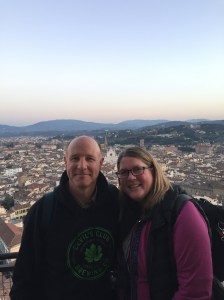
We selected 4:3o as a great time to climb to the top of the Duomo as we wanted to be at the top for sunset. This was a climb of 463 steps, some very steep, but again WELL worth the climb. The sunset was beautiful and the views of the city were stunning.
Our last stop of Florence was to walk the Ponte Vechio bridge, the ONLY bridge that the Natzi’s did NOT destroy during WWII. In the days of long ago this bridge was lined with butchers, but over the years the butchers were kicked out and it has become full of jewelry stores and other gift stores.

Florence is amazing and it is fun just to walk the streets and stop in to have a pizza and glass of wine OR some gelato!


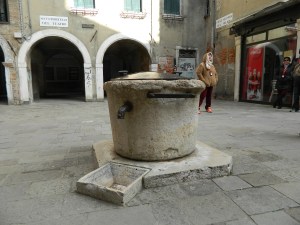
 Once back to Venice we toured around learning about the many campos that are the big squares around the city. Historically these were the gardens or fields of the area. Virtually everyone has a church, a well, and a palace. There are more than 150 churches in Venice and most are Roman Catholic.
 Ultimately we made it to St. Marco Square, the largest in Venice. It was named after St. Marco the patron saint of Venice. Most simply call it ‘the plaza’ of Venice. We toured St. Marks, (St Mark’s Basilica) the largest church in Venice. All of the gold on the outside is indeed 24 K leaf paint. It took over 700 years to decorate this church. The columns came from Turkey.
 The Horses of Saint Mark is a set of Roman bronze statues of four horses were first placed on the porch of St. Marks’s in 1204. However, Napoleon took them in 1797, and were ultimately returned in 1815. The horses stayed place on the porch of St. Mark’s until the early 1980s. At that point due to air pollution, and weather issues the originals were moved inside to the museum and the ones on the porch now are exact replicas. To view the inside of the church is free, but it is worth it to spend the 5 E to go upstairs and see the original horses and to see the view from the porch.


 timistravels